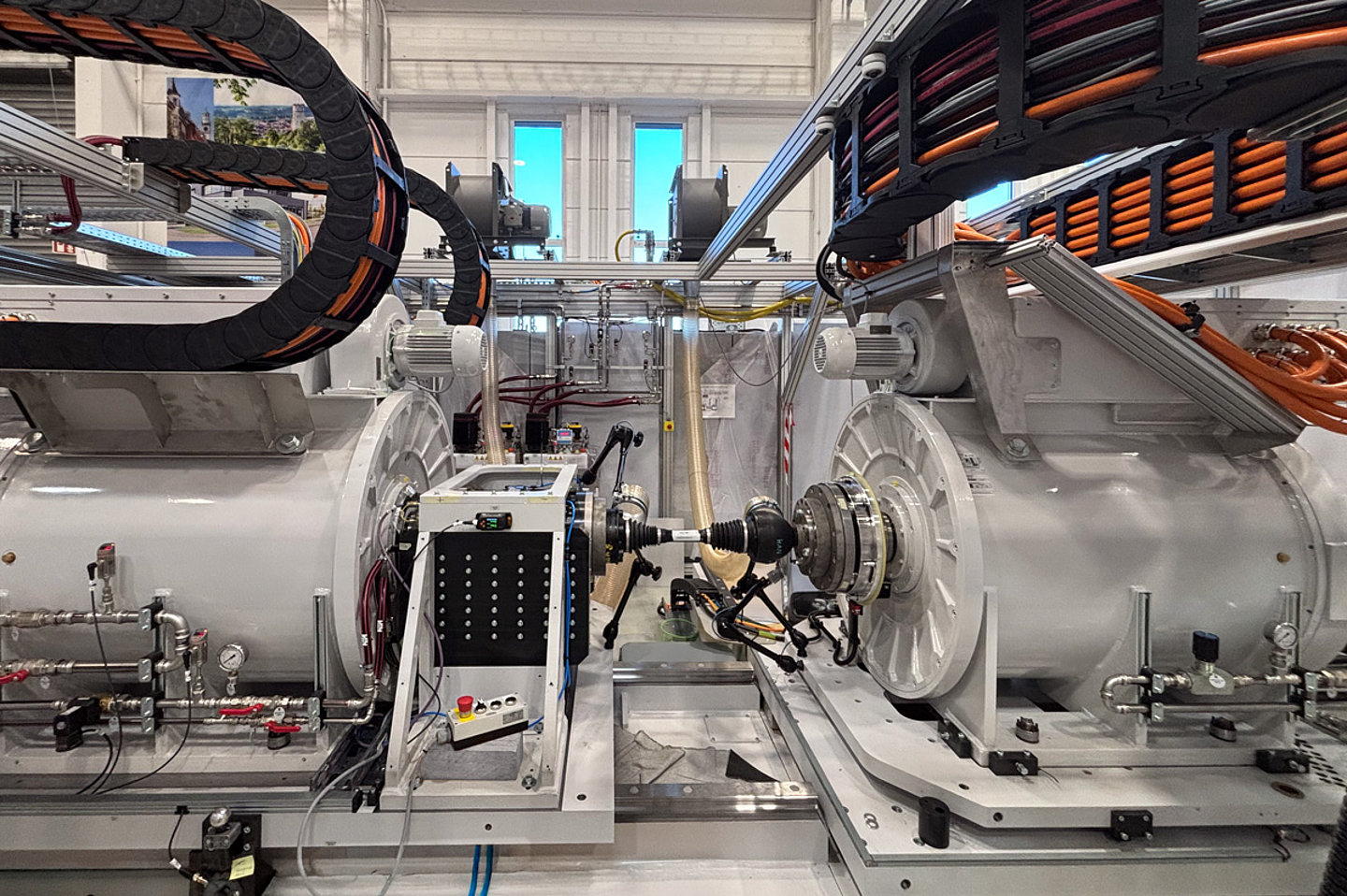

This test rig has been designed for torsional fatigue and static strength testing of drive shafts. The test specimen is subjected to specified loads and test set-ups in order to achieve the required number of cycles. The failure criteria are the attainment of defined torsional angles or the failure of the test specimen.
- Highlights
- Features
- Technical data
Equipment
- Machine bed on vibration-insulating machine shoes
- Three-phase synchronous motors
- High-precision torque measuring shafts
- Fan for airflow simulation
- Axial shaker for high and short strokes
- Axial force measuring flange for measuring generated axial forces
- Pyrometer for recording test specimen temperature
- Backlash measurement kit
- Safety housing
| Test stand dimensions (LxWxH) | Housing approx. 6800 x 4900 x 3500 (mm) |
| Control cabinet approx. 6200 x 1200 x 2200 (mm) | |
| Motor | Nominal power: 1047 kW | speed: 1000 rpm | max. torque: 10,000 Nm |
| Axial displacement | ± 100 mm| max. frequency ± 10 mm / 1 Hz | accuracy ± 0.1 mm |
| Swivel angle | -5 – 55°| max. twisting speed 10°/s | accuracy ±0.1° |
| Linear displacement | 500 mm|max. travel speed 100 mm/s | accuracy ± 0.1 mm |
| Shaker | ± 0.1 mm @ 60Hz| max. shift ± 5 mm | accuracy ±0.05 mm / 0.01 mm during shaking ± 1mm |
| Axial force measurement | max. axial force ± 10 kN (accuracy ±0.5% of maximum value) |
| Distances, test specimen length: | Flange to flange 500 – 1500 mm | flange to joint 0 – 300 mm |
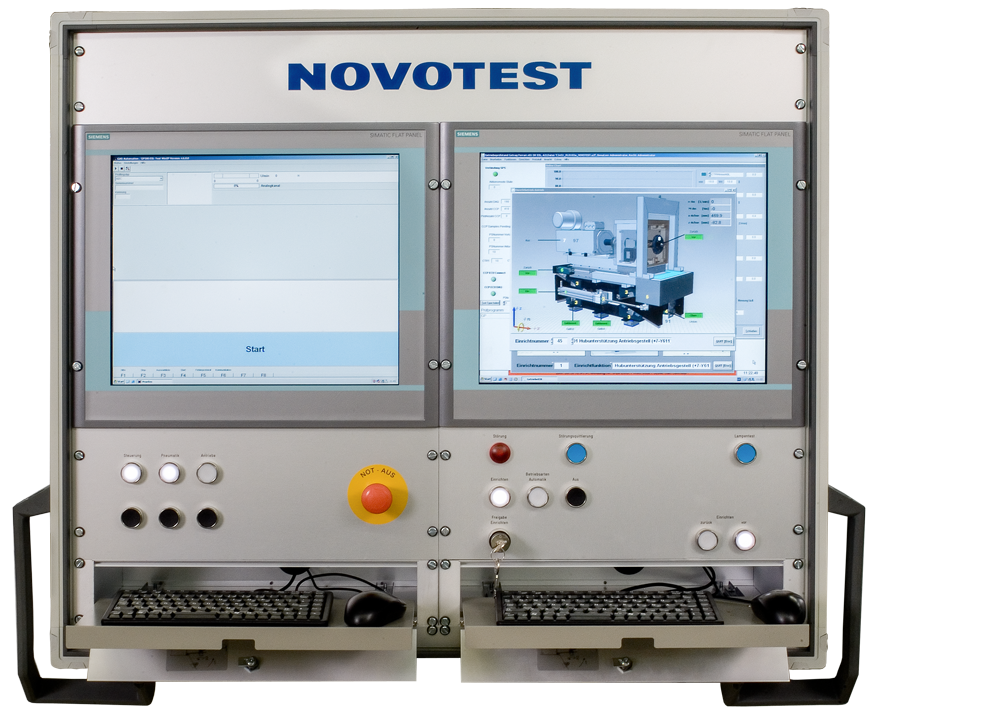
The NovoPS test stand software is a Windows-based solution that is programmed in-house and optimised for the respective test task. As the interface to the user, the uncomplicated user interface provides intuitive access to all functions of the test stand. Moreover, both the connection of the test stand to the customer's conveyor systems as well as its integration into the existing network environment is taken into account. This enables the data acquired to be processed and evaluated independently of the test stand.
Data recording
- Analogue data
- Digital data (SSI etc.)
- CAN data (with synchronisation to analogue data)
Data storage
- Data export as a text file (.csv), DIADEM file
- Database connection ODBC, MS Access, SQL Server
Creating and editing test programs
- Generation or import of test program data records
- Editing program sequences
- Evaluation within the sequences
- Free adaptation of test sequences
- On-line graphic of recorded data